
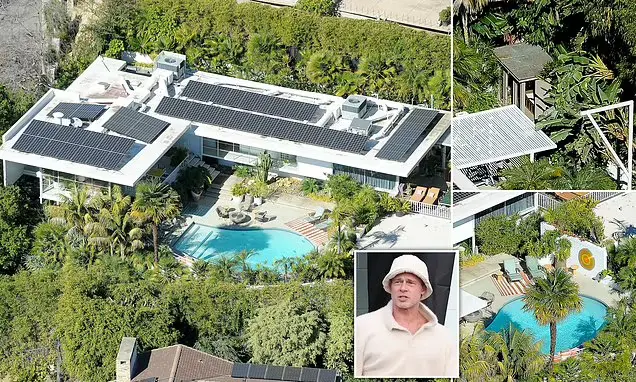

A Hollywood Icon’s Architectural Exchange
Brad Pitt has long been recognized not only as an Academy Award–winning actor but also as a passionate architecture enthusiast, a fascination that has quietly shaped his personal life and property portfolio. His latest move is the sale of his Los Feliz home, a striking midcentury modern residence affectionately known as The Steel House. While the final sale price has not been disclosed, reports confirm that the property has entered escrow in an off-market transaction, underscoring its rarity and appeal. The home briefly became the subject of headlines earlier this year when it was burglarized, though Pitt was not present at the time. Sources close to the actor indicate that his decision to part with the residence predated the incident, reflecting a larger real estate shift rather than a reaction to misfortune.
This Los Feliz dwelling holds a colorful provenance, passing through several high-profile hands before reaching Pitt. Philanthropist and Getty family heiress Aileen Getty once called it home after purchasing the property from James Valentine, guitarist for Maroon 5. In 2023, Getty and Pitt orchestrated a direct swap: she acquired his expansive Craftsman-style estate in the Hollywood Hills, valued at 33 million dollars, while he acquired The Steel House for 5.5 million dollars. For Pitt, the exchange represented a deliberate downsizing, an architectural pivot from sprawling opulence to a more restrained and intimately scaled design.
The Steel House thus became an emblem of Pitt’s evolving personal taste, a retreat that emphasized modernist lines, clean materials, and a scale suited for quiet living. That Pitt has now chosen to let it go points less to dissatisfaction and more to the natural rhythm of an individual constantly reshaping his surroundings to match his state of life and career. In a city where homes can often serve as a reflection of personal identity, Pitt’s choices continue to capture as much attention as his performances on screen.
The Steel House and Its Midcentury Allure
Constructed in the 1960s, The Steel House exemplifies the enduring appeal of midcentury modern architecture, a style defined by its harmony with landscape, open interiors, and geometric clarity. Its L-shaped hillside layout was designed to maximize both privacy and sweeping views of Los Angeles, a duality that has long made such homes coveted in the Hollywood Hills and Los Feliz neighborhoods. The interiors remain a meticulous tribute to the era, with original terrazzo floors, cantilevered eaves, and exposed beams that emphasize light, space, and proportion. These details lend the house a timeless air, a testament to the craftsmanship and ingenuity of the midcentury period.
At just over 2,000 square feet, the residence is modest in size compared to the estates often associated with A-list Hollywood names. Yet what it lacks in scale, it more than compensates for in artistry and coherence. Each of the three bedrooms is outfitted with cobalt blue carpeting, a bold design choice that channels the vibrancy of midcentury interiors. The home’s kitchen, primary bedroom, bathroom, and walk-in closet feature custom cabinetry in a pale blue tone, reinforcing the sense of continuity between color, material, and function. This combination of historic authenticity with distinctive design gestures has kept the home relevant even as architectural tastes have shifted.
The outdoor space extends the home’s midcentury narrative, balancing recreation with retreat. A swimming pool sits as the focal point of the backyard, complemented by a redwood hot tub and a freestanding sauna. These amenities speak to both luxury and simplicity. The hillside location ensures that these features are framed by views of the city, offering a visual link between private leisure and the vast urban landscape below. Together, these elements make The Steel House not simply a dwelling but a holistic experience of design, leisure, and place.
A Continuing Chapter in Pitt’s Architectural Journey
The sale of The Steel House is not an isolated decision but part of Brad Pitt’s ongoing reshaping of his California holdings. Only weeks prior, he purchased a Spanish-style mansion in the Hollywood Hills for 12 million dollars, a property that contrasts sharply with the clean modernist lines of Los Feliz. His collection also includes the historic D.L. James House in Carmel, acquired in 2022 for 40 million dollars. Designed in 1918 by architect Charles Sumner Greene, that residence has become Pitt’s primary home, symbolizing his deep appreciation for architectural history and craftsmanship.
Pitt’s acquisitions and sales reveal more than a simple accumulation of real estate. They speak to a collector’s instinct for architectural variety and historical value. Each property, whether midcentury, Spanish revival, or Greene and Greene masterpiece, represents a distinct thread in the larger narrative of American architecture. Through his portfolio, Pitt appears less as a Hollywood celebrity dabbling in design and more as a thoughtful curator, weaving together homes that embody different eras, styles, and philosophies of space.
For Los Angeles, the transfer of The Steel House adds another chapter to the city’s complex relationship with midcentury design. As homes from that era become increasingly scarce and highly valued, Pitt’s decision to part with the property ensures its story continues beyond his tenure. It will now belong to someone else who, like Pitt, recognizes the delicate interplay between heritage and modern life. For the actor, it marks yet another step in an architectural journey that has long unfolded in parallel with his cinematic career, a reminder that for Brad Pitt, the structures he inhabits are as carefully chosen as the roles he plays.