
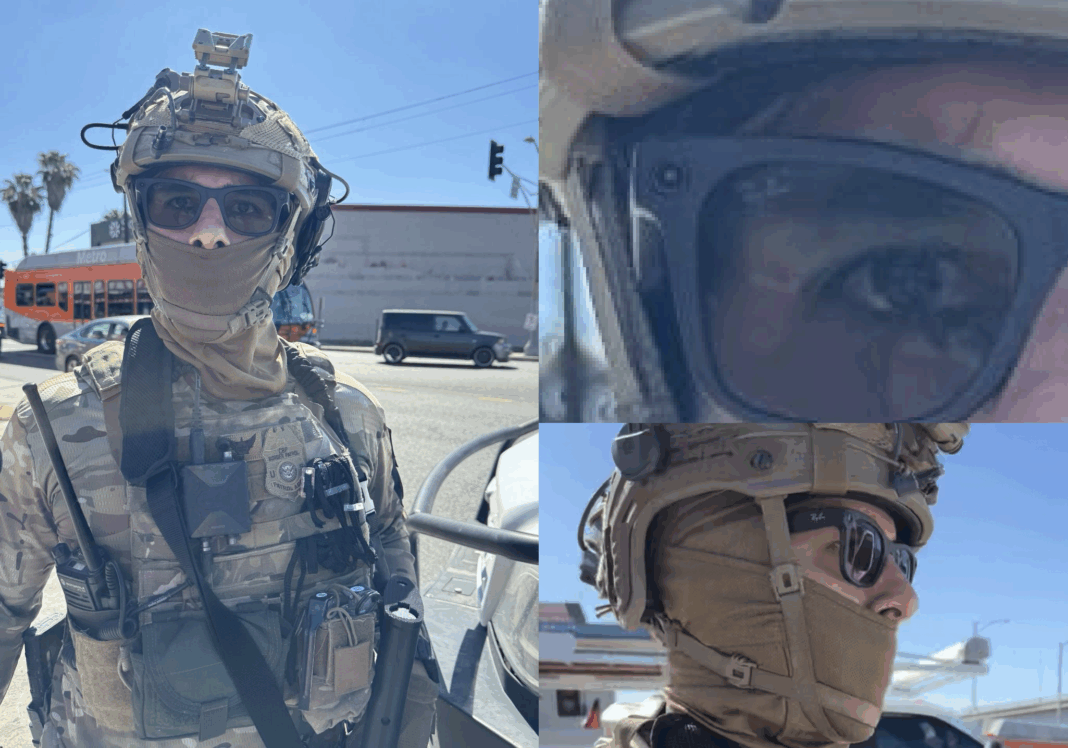

A Customs and Border Protection (CBP) agent was seen wearing Meta’s AI-powered smart glasses during a June 30 immigration enforcement operation outside a Home Depot in Cypress Park, Los Angeles. Verified photos and videos reviewed by 404 Media show the agent wearing Meta’s Ray-Ban smart glasses while dressed in full CBP uniform. The incident has raised alarms among civil liberties experts, who warn that the use of consumer-grade surveillance devices by law enforcement poses significant privacy risks.
SMART GLASSES USED IN THE FIELD WITHOUT CLEAR OVERSIGHT
The images captured during the June 30 raid show a CBP agent wearing Meta’s Ray-Ban smart glasses while interacting with members of the public. In one video, the agent gestures for someone filming to back away, with the glasses clearly visible on his face. While the footage does not confirm whether the device was recording, experts say the presence of camera-equipped smart glasses at an enforcement scene is concerning, regardless of whether the recording function was active.
Meta’s AI glasses include a built-in camera, microphones, and scene recognition capabilities, and are integrated with Meta’s AI assistant. Although the devices have an indicator light that activates during recording, the light was not visible in the footage reviewed by 404 Media. Meta does not have a known contract with CBP, and the agency did not respond to multiple requests for comment about the incident or its policies on such devices.
CBP’s current video recording policy prohibits the use of personal devices in place of department-issued systems. Specifically, the policy states that “no personally owned devices may be used in lieu of IDVRS [Incident Driven Video Recording Systems] to record law enforcement encounters.” The Department of Homeland Security (DHS) also maintains that personal devices may not be used for official law enforcement activities. The use of Meta smart glasses in this context appears to violate both sets of guidelines.
EXPERTS WARN OF SURVEILLANCE RISKS AND LACK OF REGULATION
Privacy advocates say the use of smart glasses by law enforcement could lead to unregulated surveillance, especially if deployed without agency-issued safeguards. Jake Laperruque, deputy director of the Center for Democracy and Technology, told 404 Media that even individual officers using personal devices raises complex legal and ethical questions. “There needs to be compliance with rules and laws even if a technology is not handed out through the department,” he said.
Jay Stanley, a senior policy analyst at the ACLU, expressed concern that smart glasses could be used to intimidate or secretly record individuals during encounters. He said the lack of policy enforcement under the Trump administration has enabled behavior that undermines accountability. “If an agent videotapes themselves engaging in abusive activity, are they going to be able to bury that video? Are they going to be able to turn it on and off on the fly or edit it later?” Stanley asked.
404 Media also spoke with Jeramie Scott, senior counsel at the Electronic Privacy Information Center, who warned that introducing consumer surveillance tools into law enforcement settings mirrors tactics used by authoritarian regimes. “Regardless of whether this was a personal choice by this agent or whether somehow CBP facilitated the use of these Meta glasses, the fact that it was worn by this agent is disturbing,” he said. Multiple experts noted that Meta’s smart glasses, while marketed as consumer products, now exist at the intersection of private surveillance and public law enforcement.
META’S MILITARY TIES AND SMART GLASSES STRATEGY UNDER SCRUTINY
The incident comes at a time when Meta is expanding its involvement with U.S. military and surveillance operations. The company recently announced a partnership with defense contractor Anduril to provide AI, augmented reality (AR), and virtual reality (VR) technologies through Meta’s Reality Labs division. While it is unclear how Meta’s smart glasses may factor into this agreement, the collaboration has heightened scrutiny of Meta’s role in surveillance infrastructure.
In a press release about the partnership, Meta CEO Mark Zuckerberg said the company aims to bring advanced computing capabilities to military personnel. Anduril founder Palmer Luckey added that the goal is to “turn warfighters into technomancers.” Civil liberties advocates say these developments, coupled with the use of Meta’s glasses in domestic law enforcement, signal a shift in how consumer technologies are being adopted in high-stakes government settings.
Meta declined to provide comment for the 404 Media story but questioned why its brand was being named, noting that other government-used devices like iPhones were not similarly identified in past reporting. The company has not clarified whether it plans to implement safeguards or limitations on how its smart glasses can be used by law enforcement or military personnel. Currently, the devices do not include facial recognition capabilities, though internal discussions reported by The Information indicate Meta has considered adding such features in the future.
Following the publication of the initial report, independent journalist Mel Buer shared new photos from a July 7 immigration enforcement operation in Los Angeles. In the images, two additional CBP agents appear to be wearing Meta smart glasses, while a third is seen holding a handheld camera. The expansion of these sightings suggests that the use of the device may not have been an isolated event. As more evidence emerges, the blurred line between consumer tech and government surveillance continues to prompt concern among privacy experts and civil society organizations.