
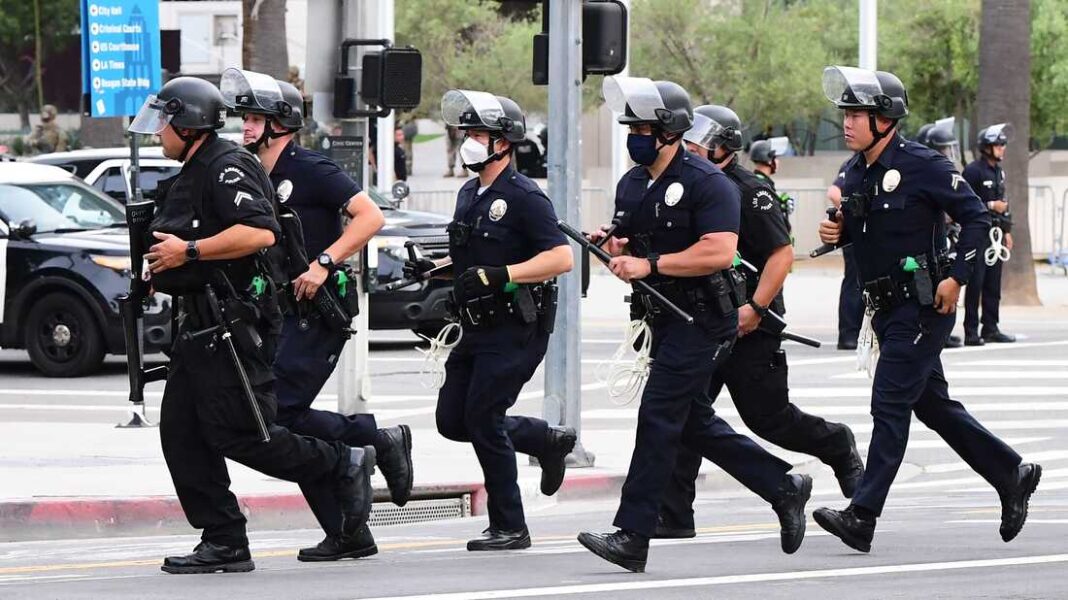

A newly launched website is enabling members of the public to identify Los Angeles police officers using facial recognition technology. The tool, hosted at FuckLAPD.com, was developed by artist and technologist Kyle McDonald and allows users to upload images of police officers’ faces to match them against a database of headshots. The site is built on records obtained through public records requests made to the City of Los Angeles.
Technology Built From Public Data
The facial recognition tool is designed to match uploaded images to a dataset of over 9,000 LAPD officer photos. According to McDonald, these headshots were obtained lawfully through records requests and lawsuits, and are part of the public domain. The system operates locally on users’ devices, meaning that no images or data are stored or transmitted through the website.
The tool’s functionality is intentionally limited. The website notes that blurry or low-resolution images are unlikely to produce accurate results. When a photo is matched, users can view the officer’s profile, which may include their name, badge number, and publicly available salary information. The profiles link to Watch the Watchers, a separate database maintained by the Stop LAPD Spying Coalition, a community organization that monitors law enforcement transparency.
McDonald clarified that his site does not scrape or extract data from third-party sources. Instead, it repackages data released by the city into an accessible tool for public accountability. He stated that the site was developed in response to instances where officers obscured their identification, especially during protests, and described it as a way to increase transparency in law enforcement interactions.
Accountability Through Facial Recognition
The launch of FuckLAPD.com has reignited discussions about privacy, surveillance, and accountability in policing. The tool comes amid growing concerns that law enforcement officers frequently avoid identification, particularly during crowd control situations or politically sensitive operations. McDonald pointed to recent protests against U.S. Immigration and Customs Enforcement (ICE) as a motivating factor for creating the site.
The LAPD has faced criticism over officers covering badge numbers or refusing to identify themselves. With this tool, individuals who believe they have encountered police misconduct can attempt to identify officers even when traditional visual cues are hidden. McDonald emphasized that the site is an act of public speech protected under the First Amendment and aimed at increasing visibility around policing practices.
Since its launch, the site has drawn around 50,000 visitors. McDonald said he does not track user behavior because the analysis occurs entirely on-device, preventing him from knowing how the tool is being used beyond public posts on platforms like Twitter and Instagram. He previously developed a similar project, ICEspy, which aimed to identify immigration officers using images sourced from LinkedIn.
Broader Context of Masked Law Enforcement and Public Concerns
The tool’s emergence follows years of increasing secrecy around federal law enforcement agents, particularly ICE officers. Reports and video footage have shown federal agents wearing masks, neck gaiters, sunglasses, and unmarked uniforms while conducting operations. Advocates argue that such anonymity impedes accountability and raises the risk of impersonation.
Cases of individuals posing as federal agents have already occurred. In Philadelphia, a man impersonated an ICE officer to rob a business. In another incident in Brooklyn, a person falsely claiming to be an immigration officer attempted to assault a woman. These examples have contributed to growing unease around unidentifiable law enforcement personnel.
ICE has defended the use of facial coverings, citing a significant increase in alleged threats and harassment against officers. The agency claims assaults on personnel rose by over 400 percent, and that doxing incidents targeting agents’ families are on the rise. However, the accuracy of these claims has been questioned by journalists and public data analysts, who point to a lack of clear supporting evidence for such statistics.
McDonald’s tool, while controversial in name and method, highlights the ongoing tension between surveillance by the state and the public’s ability to monitor those in power. As facial recognition becomes more accessible and public data more widely available, tools like this continue to raise ethical and legal questions about how information should be used and who controls it.