

Where Dinner Service Meets Italian Horsepower Frozen Mid-Gallop
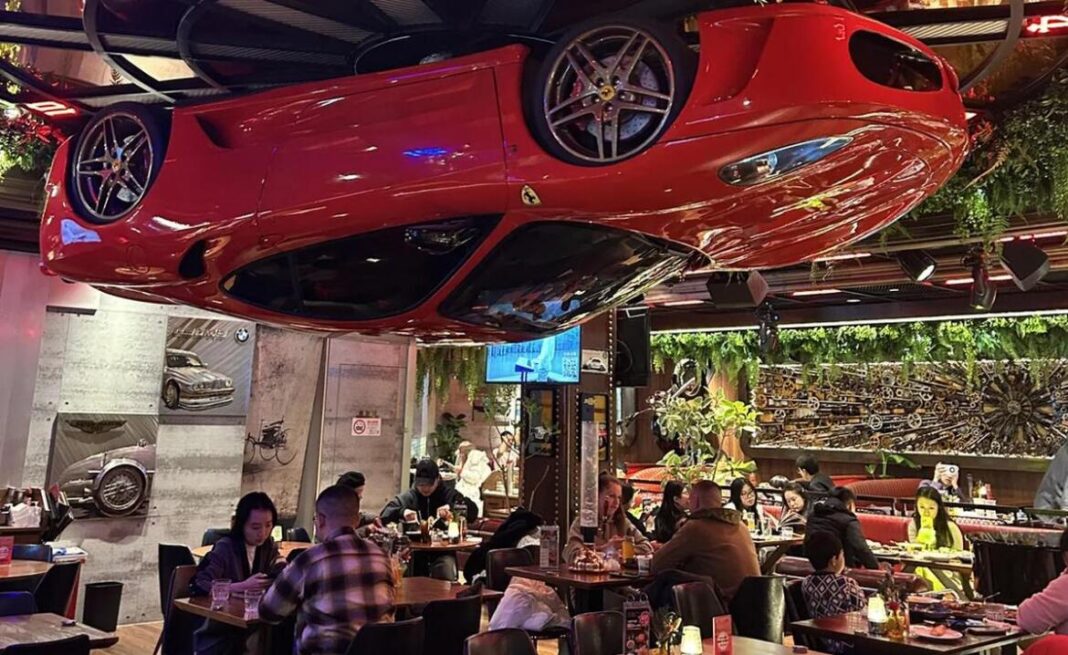
Walk into what looks like just another nightlife-driven restaurant in central Shanghai, and the atmosphere initially feels familiar enough with low lighting, loud conversations, the clink of glasses, and the faint hum of performance bravado in the air. Then you look up, and reality politely excuses itself. Suspended from the ceiling is a full-scale Ferrari F430, flipped completely upside down, its Rosso Corsa bodywork acting not as decor but as a functioning, rotating clock mechanism. According to diners who stumbled in expecting schnitzel and beer, the moment is equal parts disbelief and delight, the kind of visual punch that instantly resets expectations.
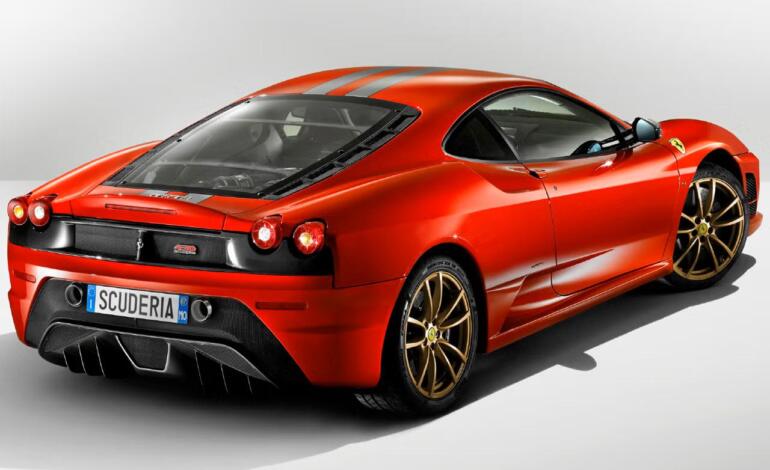
The Ferrari F430 itself is no small ornament casually bolted overhead. Measuring roughly 179 inches long, nearly 76 inches wide, and weighing in at around 3,200 pounds, this is a serious piece of machinery to hang above anyone’s head. Reportedly worth around $250,000 to $300,000 depending on condition and provenance, the supercar has been transformed into what might be the most excessive horological statement in the restaurant world. The car slowly rotates, acting as a giant timekeeper, turning the entire dining room into a kinetic sculpture that blurs the line between engineering and theater.
What makes the installation so compelling is its total lack of irony. There is no attempt to downplay the absurdity and no minimalist framing to soften the impact. This is luxury shouting from the ceiling, literally. One Reddit image that went viral recently summed it up with the understated caption “best restaurant ever,” and honestly, how do you argue with that? In a world where luxury often whispers, this Ferrari clocks in loudly.
The 1886 German Car Restaurant’s Obsession With Turning Décor Into Spectacle
The restaurant behind the madness is widely known as the 1886 German Car Restaurant, sometimes referred to as the 1886 German Automobile Restaurant, with its Bund-adjacent branch frequently tagged as the source of the now-famous Ferrari ceiling. Located around 11 Hankou Road in Shanghai’s Huangpu District, near the historic Customs House, it positions itself less as a fine-dining temple and more as an automotive playground for adults. Think German comfort food, flowing beer, live music, and a nightlife energy that leans more industrial than intimate. It is not trying to be subtle, and that is precisely the point.
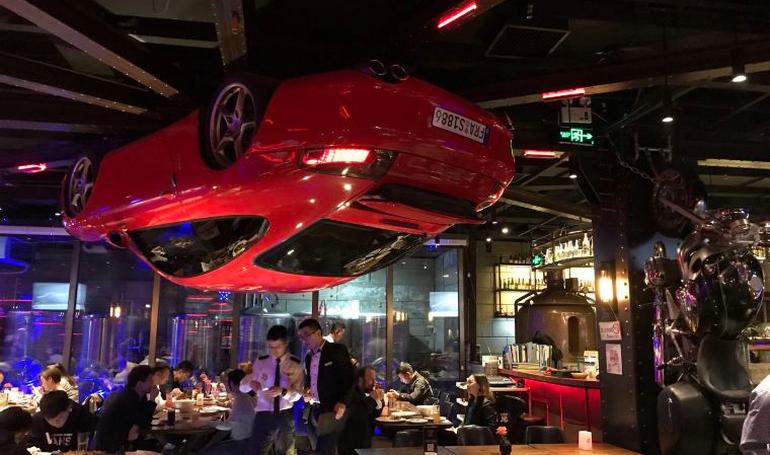
According to multiple Chinese lifestyle write-ups and visitor reviews, the space is packed with automotive references layered into every corner. Walls are crowded with car parts, vintage signage, and workshop-style elements that feel closer to a design studio than a dining room. Chandeliers shaped like pistons reportedly hang overhead, while tool-inspired details appear in places you would least expect, from cutlery to wall fixtures. There are even rumors of a bar modeled to resemble a bus, because apparently restraint was never on the mood board.
Whispers about ownership only add to the intrigue. Some local reports suggest the owner is a serious car enthusiast with access to multiple luxury vehicles, the kind of collector who might casually park a lineup of high-end cars outside a new opening just to set the tone. The name Li Shufu, the Geely founder and billionaire known for snapping up Volvo and Lotus, has floated around in speculative conversations, though never officially confirmed. True or not, the aesthetic certainly feels like it was approved by someone deeply comfortable around expensive machinery. Who else looks at a Ferrari and thinks, “Yes, let’s make it a clock”?
Why the Ferrari F430 Was the Perfect Supercar to Sacrifice to Time
Choosing the Ferrari F430 was not accidental, and anyone fluent in Maranello lore will appreciate the nuance. Introduced in the mid-2000s, the F430 marked a high point in Ferrari’s naturally aspirated V8 era, before turbocharging became the norm. Its 4.3-liter V8 produced around 483 horsepower and screamed to an 8,500 rpm redline, drawing heavily from Ferrari’s Formula One experience of the time. It was loud, raw, and unapologetically mechanical, a car built for sensation rather than subtlety.
There is something almost poetic about suspending such a visceral machine in silence and repurposing it as a timekeeper. Stripped of sound and speed, the F430 becomes a visual reminder of motion without movement and aggression frozen mid-performance. Whether the installation uses a real chassis or a meticulously crafted display is a detail that almost feels beside the point. The impact comes from the idea itself, from the audacity of reducing Italian automotive fury to minutes and hours passing overhead.
Luxury, after all, thrives on reinvention and shock value. Plenty of restaurants try to be memorable with celebrity chefs or imported marble, but very few are willing to strap a Ferrari to the ceiling and let it dictate the rhythm of the room. According to those who have experienced it, the clock even chimes every 15 minutes, turning time into a communal event rather than a private glance at a wrist. In a city already saturated with spectacle, this upside-down F430 still manages to stand out. And really, isn’t that the ultimate luxury flex, making time itself revolve around your taste?