
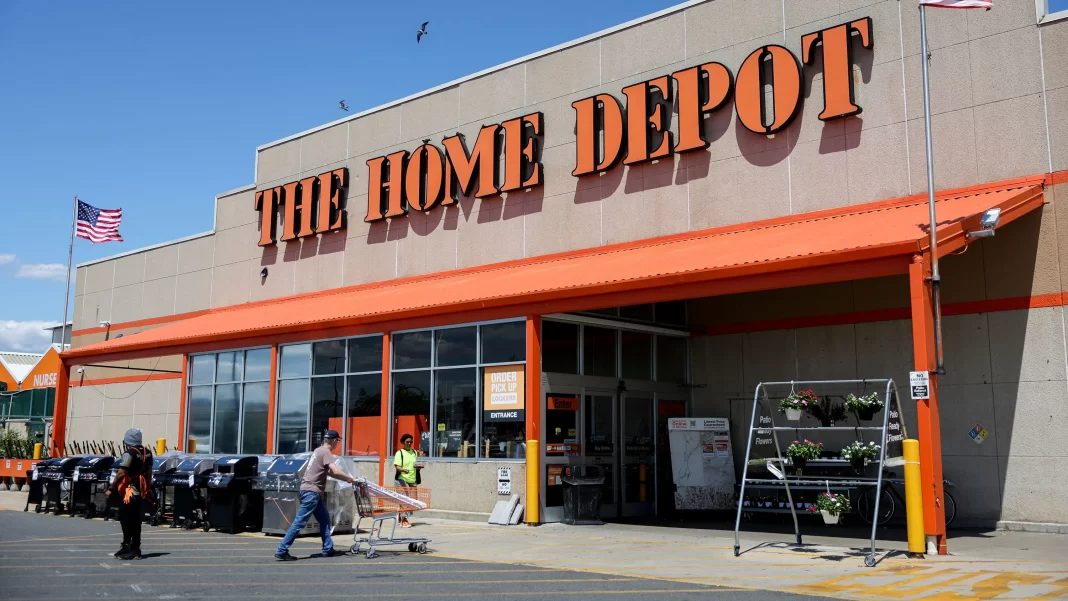

Automated license plate reading (ALPR) cameras installed at Home Depot and Lowe’s stores across the United States are feeding into a growing police surveillance network, according to public records obtained by the Electronic Frontier Foundation (EFF). The documents, shared with 404 Media, reveal that law enforcement agencies have access to footage from hundreds of AI-powered cameras at these retail locations. While the cameras are operated by private businesses, they are integrated into systems used regularly by law enforcement for monitoring and investigations.
RETAIL SURVEILLANCE DATA SHARED WITH LAW ENFORCEMENT
The Johnson County, Texas Sheriff’s Office confirmed through the records that it can access Flock Safety camera data from 173 Lowe’s stores nationwide, as well as dozens of Home Depot stores across Texas. Flock Safety is a surveillance technology company that supplies ALPR cameras to both police departments and private clients. These cameras continuously scan and record license plates, tracking vehicle movements without requiring a warrant.
Flock’s network allows law enforcement to access camera data across jurisdictional lines if the participating entity opts into data sharing. According to Flock, private companies do not have the same statewide or national sharing privileges as public agencies. However, the public records suggest that Lowe’s and Home Depot have entered into multiple data-sharing agreements that allow police departments, including those outside the state, to access footage collected on their properties.
Although Flock stated that private-to-police data sharing occurs on a one-to-one basis, the records show broad access. Johnson County, for example, can review footage from Lowe’s locations in Illinois, Indiana, and Michigan, despite being based in Texas. This level of access suggests widespread collaboration between the retail chains and law enforcement agencies, though neither Lowe’s nor the sheriff’s office responded to requests for comment.
CAMERA TOOLS INCLUDE REAL-TIME ALERTS AND GUNSHOT DETECTION
The documents reviewed by the EFF also reveal details about the specific surveillance tools used. Home Depot stores in Texas have enabled Flock’s “Hotlist Tool,” which allows police to flag certain license plates and receive real-time alerts when a flagged vehicle is detected. This capability is promoted by Flock as a feature that enables proactive policing by notifying authorities when wanted vehicles enter a monitored area.
Additionally, some Home Depot stores have activated Raven, Flock’s gunshot detection system, which uses microphones to identify and respond to gunfire. These systems, typically associated with law enforcement, are now part of the surveillance infrastructure deployed at retail locations. The EFF’s records show that none of the Lowe’s stores with Flock cameras had the Hotlist feature enabled, though the exact criteria for enabling such features remain unclear.
Flock emphasizes that all private camera integrations require formal agreements with law enforcement and customer consent. On its website, the company describes public-private partnerships as key to its mission of crime prevention. In a blog post, Flock wrote that private customers can opt into these arrangements through signed memorandums of understanding with local agencies. However, the scope and terms of these agreements are rarely disclosed publicly.
GROWING PUBLIC-PRIVATE SURVEILLANCE RAISES PRIVACY CONCERNS
The expansion of ALPR networks through corporate partnerships raises questions about customer privacy and oversight. Home Depot’s privacy policy states that it may share data with third parties for safety, property protection, and legal compliance. When asked about its collaboration with Flock, a Home Depot spokesperson told 404 Media that the company works with law enforcement to prevent retail crime but declined to comment on the specifics of its data-sharing practices.
The EFF’s investigation provides one of the clearest glimpses into how these systems operate at scale. A 173-page document obtained through public records requests lists thousands of searchable entities accessible to the Johnson County Sheriff’s Office, including locations far beyond Texas. According to 404 Media’s reporting, similar patterns have been seen with other retailers and property owners who have enabled Flock or competing services like Vigilant, allowing police access to private surveillance footage.
Flock’s integration with major retail chains underscores how surveillance systems are increasingly built on partnerships between public agencies and private companies. While the technology has been credited with solving theft and fraud cases including a reported $20 million gift card scam targeting Lowe’s and Home Depot, civil liberties advocates warn that unchecked surveillance could expose innocent people to unnecessary scrutiny. Critics argue that the public often remains unaware of the extent to which their movements are tracked through routine visits to everyday locations.
As the use of ALPR and related surveillance tools continues to expand, the line between public and private monitoring is becoming increasingly blurred. Without clearer transparency requirements or legal safeguards, customers may not know when their vehicle data is being captured, shared, or used by law enforcement far beyond the parking lot where it was collected.