
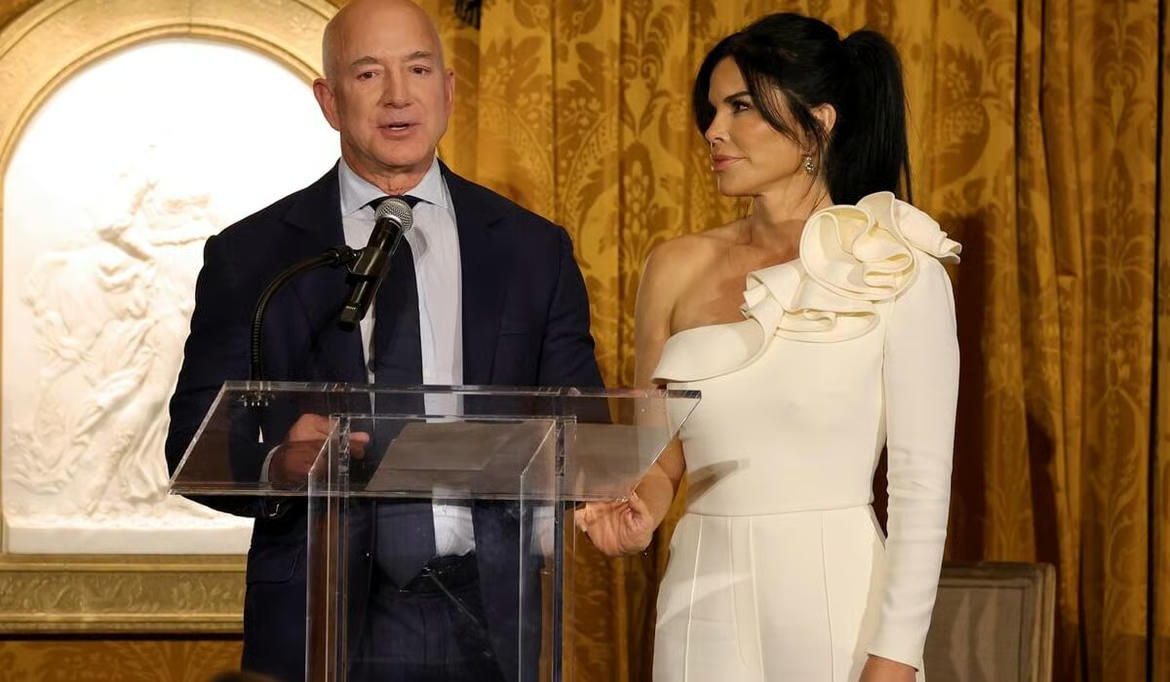

While the world applauds MacKenzie Scott’s headline-making donations, Jeff Bezos, the $245-billion third-richest billionaire, has quietly sent nearly $12 million to fight homelessness around Washington, D.C., a sum that feels almost surreal beside his reportedly $500-million, 417-foot Koru sailing superyacht, its 246-foot support vessel Abeona, and the gleaming rockets, mansions, and society soirées that usually define his orbit
A quiet check from the loudest wallet in tech
Picture Washington, D.C. at dusk, where the marble glows, motorcades slip by, and philanthropy usually comes with a press line and a photo op. Instead, Bezos has reportedly opted for something far more understated, a near $12 million infusion into the region’s homelessness fight while public attention is still fixed on his ex-wife’s generosity. The contrast is very Bezos: no podium, no gala, just a high-velocity transfer that lands where it is needed. He is said to be worth around $245 billion, so yes, $12 million is a rounding error. Still, rounding errors in billionaire math can be life-changing for families without stable shelter.
This is not a spontaneous act of charity that popped up between yacht cruises and space launches. The Day 1 Families Fund, a nonprofit founded by Bezos, has been operating like a long-term philanthropic engine since 2018. It made a $2 billion commitment to organizations fighting family homelessness, and it has been distributing major grants annually across the U.S. The year 2025 alone brought $102.5 million to 32 nonprofits nationwide, including this D.C. windfall. The fund is structured for repeat impact, not splashy sentiment. If you follow the pattern, you can almost see the strategy grid beneath the generosity.
And yes, it is impossible not to notice the lifestyle backdrop. This is the same man who sails on Koru, a 417-foot three-masted schooner reportedly priced around $500 million, with a shadow support vessel stretching 246 feet. When your leisure footprint is measured in hundreds of feet of teak, carbon fiber, and sailcloth, any philanthropic gesture invites scrutiny. But perhaps that tension is the point of modern billionaire giving. The ultra-wealthy can live in a floating palace and still choose to intervene in a crisis on land. The question is not whether the contrast exists, but what it produces.
Where the money lands: four nonprofits, four strategies
Here is where the story becomes more than a headline because the dollars are not drifting into a vague cause. The nearly $12 million was divided among four local grantees, each with a distinct mandate and a track record in the region. Community Crisis Services, Inc., LifeStyles of Maryland, Friendship Place, and Harford Family House all received funding tailored to their strengths. This looks less like scattered generosity and more like a portfolio approach. Different needs, different tools, same mission: get families housed faster and keep them there. It is philanthropy run with the precision of an investor’s playbook.
Community Crisis Services received $5 million, the largest chunk, and its focus is very specific. The organization targets families dealing with physical or intellectual disabilities, a demographic often hit hardest by housing instability. Even more telling, the funding is expected to be deployed over five years, giving the nonprofit operational breathing room. Multi-year support lets organizations plan staffing, build sustainable programming, and avoid the exhausting scramble of annual fundraising panic. It is long-horizon giving, which is rarer than people realize. In philanthropy, time can be as valuable as cash.
Friendship Place collected $2.5 million to expand rapid financial assistance so families can exit homelessness faster. That kind of intervention is essentially a fast-acting bridge, covering deposits, shortfalls, and emergency bills before a crisis becomes permanent. This is also the charity’s second identical grant from the Day 1 Fund, after receiving the same amount in 2020 during the pandemic. Repeat funding signals confidence, and in the nonprofit world, confidence is currency. LifeStyles of Maryland also received $2.5 million to move families from acute crisis into sustainable housing pathways across Southern Maryland. Harford Family House was granted $1.25 million to expand emergency shelter and deepen partnerships with county public schools, which are often the first place family instability shows up.
Philanthropy with a billionaire backdrop
Let’s be honest, Bezos’ giving always lands in the shadow of spectacle. Koru is not just a yacht, it is a roaming symbol of surplus, with the kind of scale that turns harbors into paparazzi stages. The vessel’s towering masts, enormous displacement, and sleek sailing profile place it in the rarefied tier of heritage-inspired superyachts. Add a 246-foot support ship trailing behind like a luxury command center, and you get a floating lifestyle that feels almost mythic. Against that setting, a homelessness grant can look modest. Yet modest is a relative term when the check is still big enough to reshape local capacity.
What makes Day 1 Families Fund interesting is that it does not read like a cosmetic brand polish. The program has a clear national footprint, a consistent annual grant rhythm, and a narrowed focus on families, not just individuals. The leadership awards component nudges the ecosystem toward innovation and scale, rather than one-time relief. The grants are meant to help families transition out of homelessness quickly, which is exactly where many systems fail. You can feel the operational logic behind it, a kind of philanthropic efficiency that mirrors Bezos’ business instincts. If this is legacy building, it is being built with spreadsheets, not speeches.
So while MacKenzie Scott’s donations are rightly celebrated for their visibility and velocity, Bezos is playing a quieter game with a similarly serious intent. One approach floods the headlines, the other floods the infrastructure. Both matter, and families in D.C. are the immediate winners here. A warmer night, a faster exit from crisis, a shelter bed that exists because a billionaire’s fund showed up on time, these are tangible luxuries in their own right. The ultra-rich may live in worlds of carbon masts and orbital dreams. But sometimes the most consequential luxury is simply giving people a safe place to sleep.