
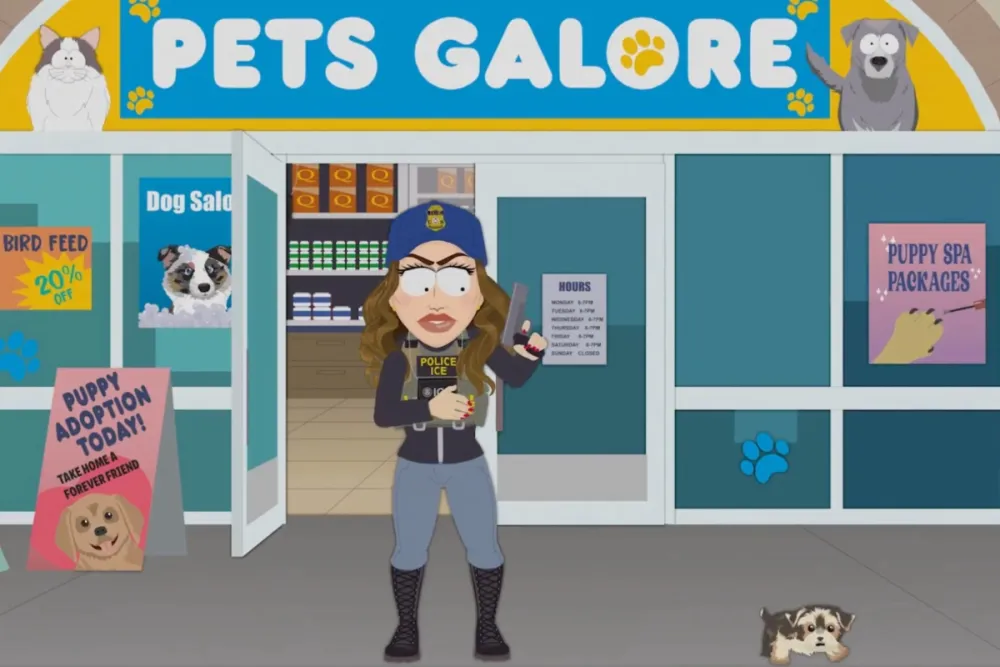

Kristi Noem is once again at the center of a “South Park” firestorm. This time, the show unleashed a scene so graphic and jarring that it has ricocheted across social media in a matter of hours. The newly revealed footage, hidden in the Paramount+ post-credits of Season 27’s second episode, shows the United States Secretary of Homeland Security striding into a pet store with cold precision before opening fire on the row of helpless puppies inside. The animated version of Noem spares no hesitation in pulling the trigger, each blast cutting through the cheery, brightly lit store with brutal contrast. One desperate dog manages to make a break for it, darting toward safety, but Noem’s animated counterpart closes the distance quickly. She raises her weapon, aims, and fires again. The sequence ends with the small animal collapsing lifeless to the floor.
The Scene That Went Straight for Shock Value
The Paramount+ post-credits sequence went live on Monday through the official “South Park” X account. Viewers who tuned in on streaming were met with an uncut, high-impact portrayal that had not been part of Comedy Central’s televised version of the episode. The scene opens with Noem’s character pushing into the store as if on a mission, her expression flat and unyielding. Gunfire erupts without warning, shattering the harmless atmosphere as animated bullets tear through the rows of puppies. One animal bursts toward freedom in a frantic sprint for its life, but the escape lasts only seconds. The character gives chase with relentless focus, catches up to the fleeing dog, and ends the scene with a final, merciless shot. The detail in the animation leaves nothing to interpretation, making it one of the most pointed depictions the show has released in recent years.
The choice to keep this content exclusive to Paramount+ raised immediate questions. “South Park” has long been known for its week-to-week production cycle, a method designed to keep storylines and references razor sharp and relevant. That quick turnaround leaves little time for extra animation, meaning some material can be left unfinished by the time the televised cut airs. It is possible the production team did not have time to finalize this sequence for Comedy Central’s initial broadcast, instead saving it for the streaming drop. Whatever the reason, the release strategy ensured the scene would not just reach audiences but dominate online discussion. Within hours of the post, social platforms were flooded with clips, stills, and commentary dissecting every frame.
The episode itself had already given Noem an aggressive, unflattering role. She was cast as the merciless, puppy-killing head of ICE, storming into a live children’s theater production of “Dora the Explorer Live!” and bringing chaos to the stage. The design of her animated face was equally ruthless, featuring skin that repeatedly melted away in grotesque waves due to botched plastic surgery. Fans described the portrayal as some of the most savage satire “South Park” had unleashed in years. By the time the Paramount+ clip surfaced, the episode had already cemented itself as one of the season’s most provocative offerings.
Noem’s Public Pushback Was Immediate and Blunt
Kristi Noem did not let the portrayal pass without a fight. Appearing on Glenn Beck’s radio show soon after the episode aired, she blasted the depiction as “so lazy” and “petty.” Her criticism centered on what she saw as cheap shots at her physical appearance, saying the creative choice to mock her looks instead of her policies was weak. Noem made it clear that she had not personally watched the episode, telling Beck she was busy reviewing budget numbers at the time. She also positioned the attack as part of a pattern, describing it as the work of “liberals and extremists” who, in her view, routinely target women for how they look rather than for their professional decisions. Her words framed the satire as shallow and lacking in substance.
She went further by inviting the show’s writers to challenge her on her actual work, stating that if they wanted to critique her job performance, they should “go ahead and do that.” Instead, she argued, they opted for what she viewed as an easy and irrelevant angle. The exchange with Beck sparked fresh media coverage, with multiple outlets picking up her statements. Her refusal to even watch the episode became its own headline, underscoring how divisive the animated attack had become. Critics and supporters alike seized on her comments as proof of the widening cultural battle lines between political figures and satirical media.
For Noem, the controversy added to a growing list of public clashes with pop culture. The tone of her response suggested she saw the portrayal not as clever political commentary but as personal mockery dressed up as humor. Whether that stance would change public perception remained to be seen, but the debate over her animated likeness was already in full swing. It became another chapter in the larger conversation about how far satire should go when targeting real-world political figures. By the time the segment wrapped on Beck’s show, the buzz had already hit a fever pitch online.
A Joke With a Controversial Real-Life Origin
The origins of “South Park’s” dog-shooting gag did not come from thin air. They trace directly to a real-life incident described by Noem herself in a book excerpt. In it, she admitted to shooting her own dog, a hunting pup named Cricket, because she said it was too aggressive and unmanageable. That confession has lingered in public memory and became an easy shorthand for critics looking to paint her in a harsh light. By weaving that moment into an over-the-top animated sequence, “South Park” locked its satire to a factual foundation that viewers could instantly recognize. The decision ensured the joke landed with a double impact—equal parts political caricature and pointed callback.
Season 27 of the long-running series has been unapologetically political from its opening episode. The premiere ignited its own storm by portraying Donald Trump begging Satan for sex, a scene that pulled instant headlines. That moment drew a rare and sharp rebuke from the White House, which issued a statement dismissing the show as irrelevant for over 20 years. The statement described the current creative direction as “uninspired ideas in a desperate attempt for attention,” signaling that the political establishment had no interest in taking the satire seriously. The comment itself, however, only added fuel to the fire, giving the season’s narrative even more coverage.
With two episodes already triggering strong political backlash, “South Park” appears to be leaning fully into controversy as a creative strategy. The Kristi Noem storyline is just the latest proof that the series is willing to mine public records, real-life quotes, and infamous incidents for maximum impact. Whether audiences are laughing, gasping, or fuming, the show has once again ensured its place in the cultural conversation. And as long as clips like this keep surfacing, the storm around Season 27 is unlikely to calm anytime soon.