

Early Legal Action Targets AI Videos Featuring Celebrity Likeness
LeBron James has taken legal action against an AI company following the circulation of nonconsensual, AI-generated videos that featured the NBA star in false and often bizarre scenarios. One widely viewed video portrayed him as pregnant. These clips were shared across social media and drew significant attention. According to internal communications and public statements reviewed by 404 Media, attorneys for James issued a cease and desist letter to Interlink AI. This platform operated through a Discord server and used AI tools to generate content based on real people.
The videos were created using a tool called Interlink AI that ran on a content engine named FlickUp. These clips had been circulating for several months. Many featured James and other public figures in fictional or unsettling scenes. Some of the most viral content showed James in a prison setting alongside AI-generated versions of other celebrities. Others placed him in fabricated and compromising situations. Detailed creation guides within the Interlink Discord community enabled users to produce and distribute the videos. Several of these were shared widely on platforms like Instagram.
After receiving the legal warning, Interlink moderators announced that they would remove all realistic person-based models from the platform. The moderators stated that this decision was made to avoid additional legal trouble. In a message shared with users, they explained that the change followed legal complications involving a high-profile basketball player. They said they had chosen to take a preventative step and eliminate all realistic likenesses from the system.
Interlink and FlickUp Respond to Cease and Desist Letter
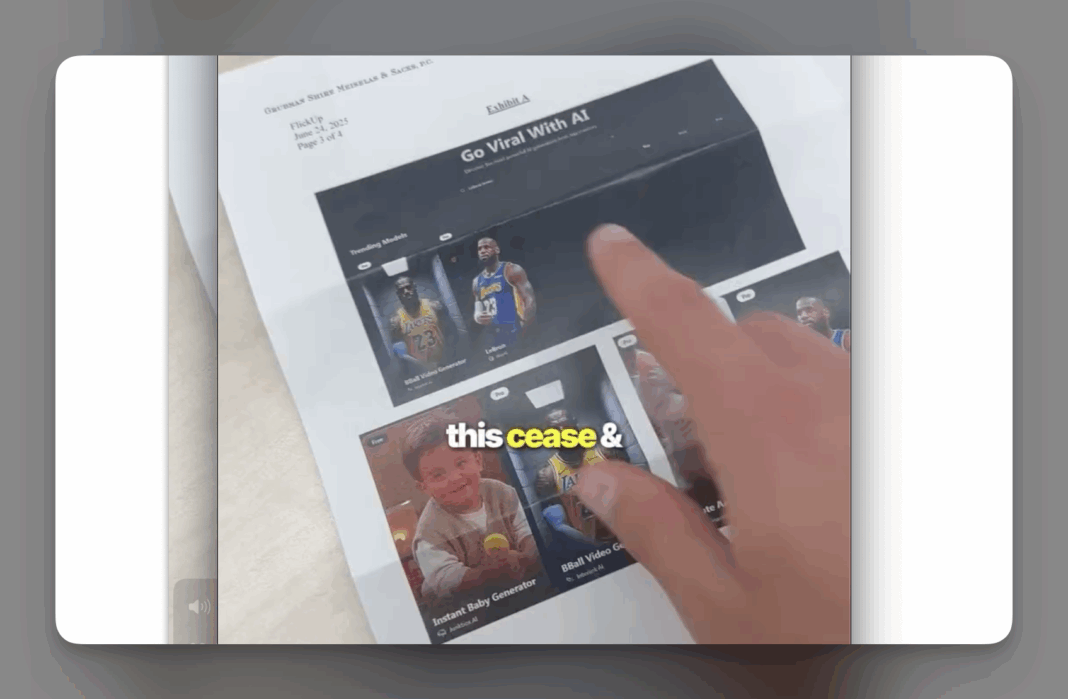
Jason Stacks, founder of FlickUp, confirmed to 404 Media that the cease and desist letter came from the law firm Grubman Shire Meiselas & Sacks, which represents LeBron James. According to Stacks, the company responded quickly by removing all AI-generated likenesses from its software. He said the decision was made within thirty minutes of receiving the legal notice. In his statement, he identified Interlink AI as the source of the disputed content.
Although he declined to share the full legal document, Stacks referenced the letter in both a written response and a video shared on social media. In that video, he briefly displayed a printed excerpt from the letter that included the name of the law firm and spoke about the seriousness of the situation. He described it as a letter from one of the most prominent NBA players in history and said that the platform had attracted growing attention before legal action was taken.
The Discord server that hosted the Interlink AI community had long encouraged users to create content using the likenesses of celebrities. A now-deleted channel focused on basketball had included instructions for generating videos featuring James, along with user-submitted creations. One of the most widely shared videos showed AI versions of James, Steph Curry, and Diddy inside a prison. That video reportedly gained more than six million views. Interlink also developed models based on other celebrities, including Elon Musk, Drake, and Mr. Beast.
Deepfake Controversy Highlights Broader Industry Concerns
This dispute brings new visibility to a growing concern in generative AI. Increasingly, platforms are enabling users to create synthetic media using real individuals’ likenesses without permission. While deepfake pornography has received public scrutiny, many nonsexual deepfakes remain legally unaddressed. These can still be harmful, particularly when they depict public figures in surreal or defamatory ways.
LeBron James’ legal response marks one of the first known examples of a high-profile celebrity formally challenging the use of their likeness in nonsexual AI-generated videos. This move may signal a wider shift among celebrities who are no longer willing to ignore these forms of unauthorized media. As generative tools become easier to use, such content is likely to continue expanding in both volume and reach.
Instagram has reportedly taken down at least three accounts linked to the viral AI videos featuring James. When contacted for comment, Meta, the parent company of Instagram, did not confirm whether it had also received a cease and desist letter. Within the Interlink community, some users had previously shared posts celebrating engagement from celebrities. One example included a screenshot that appeared to show rapper 50 Cent liking one of the AI-generated videos.
Shifting Policies and Future Legal Pressure on AI Creators
Stacks said that the company has since revised its internal guidelines to avoid further legal trouble. He emphasized that the platform had removed the AI models and was working on a safer path forward. Despite the takedown of realistic likenesses, Interlink AI plans to continue developing its tools. The company intends to pivot toward more fictional and generalized content.
Legal experts and digital rights advocates have raised concerns about the lack of regulation in this space. Without stricter oversight, AI platforms may continue to support the creation of unauthorized and potentially harmful synthetic media. Some hosting providers and payment processors have already begun distancing themselves from services that offer tools for deepfake generation, especially when real individuals are involved.
As more celebrities begin to confront these practices through formal legal action, their efforts may shape the direction of the entire AI content landscape. The case involving FlickUp and Interlink AI may serve as a benchmark in establishing how platforms handle likeness rights, especially in the absence of clear legal boundaries. For now, LeBron James’ legal move has forced at least one company to rethink its policies. This represents a significant early step in the ongoing conversation about AI, identity, and consent.