
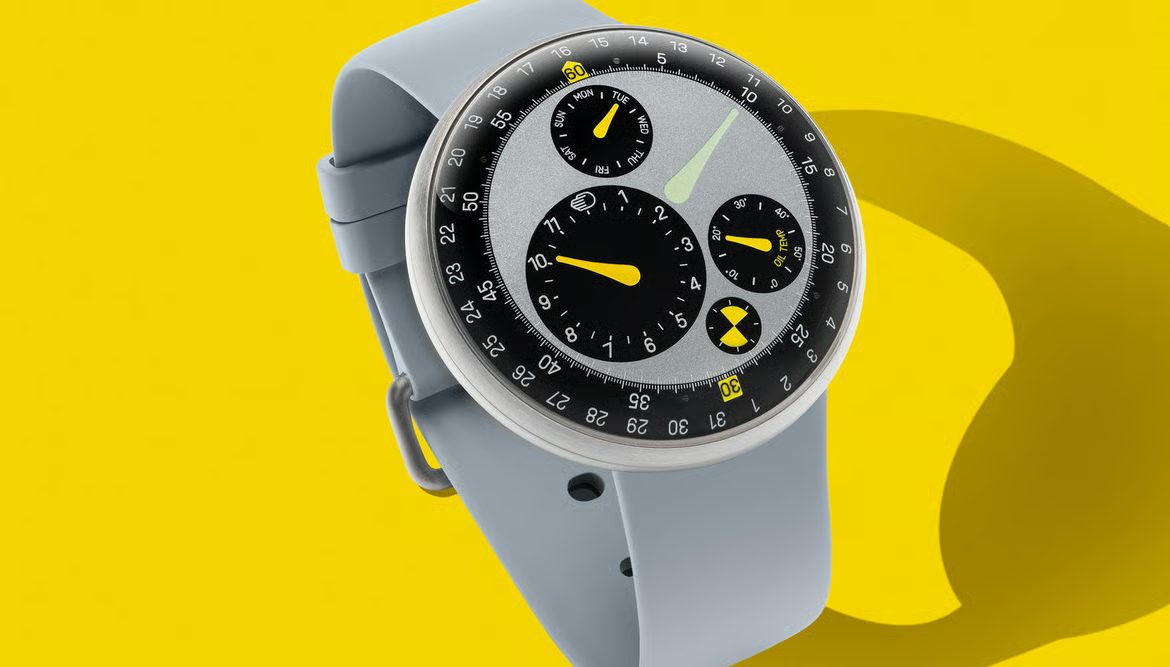

He shaped the Apple Watch for the late billionaire Steve Jobs’ empire and sketched $350 million, 140-meter behemoths like Solaris, yet Marc Newson now pivots to a $57,000 oil-filled mechanical surprise: the 45 mm × 15 mm titanium Ressence Type 3 MN, just 80 pieces, 95 grams light, proving a tiny wrist pebble can rival a superyacht in swagger.
From superyacht scale to wrist-borne intimacy: Newson’s comeback to mechanics
It’s a deliciously cinematic plot twist when a designer who has spent years thinking in aircraft cabins, furniture silhouettes, and floating palaces turns his gaze to a 45 mm object you can tuck under a cuff. According to Ressence, the meeting with Marc Newson “always felt inevitable,” and honestly, who’s surprised when two iconoclasts collide? Newson reportedly has that rare ability to make anything, whether a $350 million superyacht or a dinner chair, feel inevitable in hindsight. Now the TYPE 3 MN arrives like a quiet mic drop, an ultra-mechanical counterpoint to the digitized world he helped shape at Apple. And isn’t there something almost poetic about the Apple Watch’s co-author returning to purely mechanical time, as if to remind Silicon Valley what real engineering romance looks like?
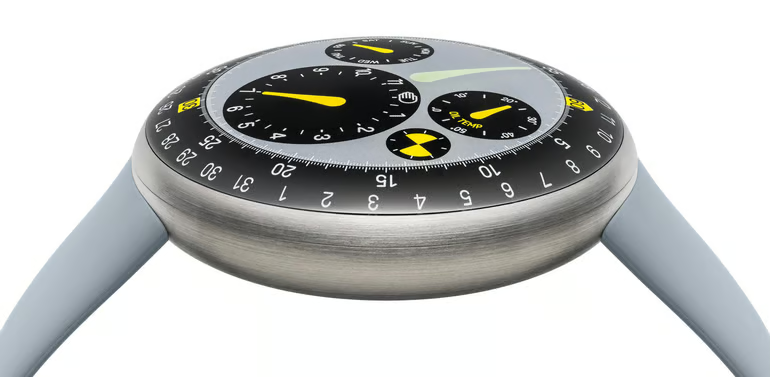
The TYPE 3 MN leans hard into the pebble-smooth visual language Newson pioneered with Ikepod and refined through Cupertino minimalism. The case is Grade 5 titanium, and you feel that choice immediately in the way the watch reads as a single, continuous gesture rather than a stack of parts. There are no sharp breaks, no fussy facets, no “look at me” bevels, just a seamless flow from case to crystal to strap, like something polished by decades of touch. The double-domed sapphire crystal sits atop the case like a bubble, a subtle nod to that “glass-as-interface” fetish Apple made mainstream. Worth around CHF 46,000 before taxes, it’s not buying you ornate finishing for its own sake; it’s buying you Newson’s obsessive ergonomic calm. The question isn’t whether it looks modern, it’s whether anything else looks this inevitable.
What makes this feel less like a celebrity cameo and more like a genuine design conversation is how un-branded it is. The palette, soft green, grey, black, with a single yellow accent, whispers instead of shouts, as if the watch is too secure in itself to chase attention. Newson is said to dislike visual noise, and the MN shows it with almost defiant restraint: minimal text, no dial clutter, only information presented with surgical clarity. You can practically see the Apple Watch DNA in the way each element is spaced and prioritized, but the effect is warmer, slower, more human. There’s a quiet confidence in a watch that doesn’t need to scream its lineage to feel important.
Oil, orbiting discs, and the illusion of a digital screen on glass
The heart of the TYPE 3 MN’s drama is its oil-filled upper chamber, a trick Ressence describes as eliminating refraction so the dial looks like it’s floating right on the surface. It’s the kind of engineering that makes watch nerds lean in closer and casual observers blurt out, “Wait, how is that even possible?” Reportedly, the oil creates a “digital-screen” clarity, where indications don’t sit beneath the glass but hover on it, as if time itself is printed on air. This is where Newson’s digital-era intuition clicks perfectly with Ressence’s old-school weirdness. Apple achieved that “content on glass” illusion with pixels and touch; Ressence does it with fluid physics, rotating discs, and magnetic transmission. Different centuries, same magic trick, and it’s honestly thrilling to see them rhyme.
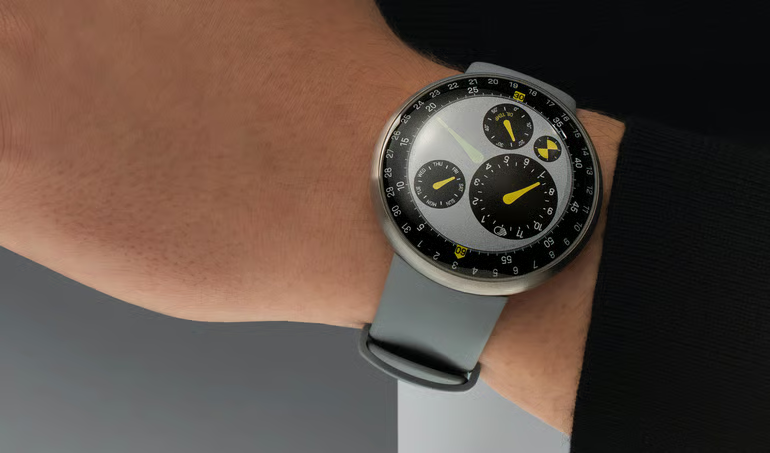
Under the crystal, the ROCS (Ressence Orbital Convex System) module runs the show like a miniature planetary ballet. The hours, minutes, running seconds, day, date, and even oil temperature are displayed on Grade 5 titanium discs, arranged as biaxial satellites in an orbital system. If you love technical watchmaking, this is candy: engraved Super-LumiNova fills the indications, and the whole dial behaves more like a living interface than a static face. It’s not just telling time; it’s choreographing it, with each disc gliding in synchronized arcs that feel almost software-like. And yet, there’s no software at all, only mechanical decisions translated into motion. In a world of sterile complications, this feels like an interface designed by someone who understands both delight and restraint.
The MN remains deliciously stubborn in one key way: it is purely mechanical, no electronics, no notifications, no digital safety net. Its 36-hour power reserve is modest on paper, but it suits the watch’s philosophy; this isn’t a battery-backed companion; it’s a living object you engage with. According to the brand, magnetic transmission keeps the oil-filled dial isolated from the movement below, a smart separation that protects precision while maintaining that signature floating effect. It performs a single function, telling time, but does so by challenging nearly every convention of dial architecture. There’s something quietly rebellious about a designer who helped make smartwatches ubiquitous now delivering a watch that does nothing “smart” except rethink how we see minutes.
80 pieces, featherweight titanium, and a price that dares you to blink
Let’s talk numbers, because this is where luxury gets spicy. The TYPE 3 MN measures 45 mm across and 15 mm thick, a size that sounds bold until you notice the case’s rounded, pebble-like profile makes it sit softer than most 42s. At 95 grams including strap and buckle, it’s almost comically light for something this technically dense, thanks to that Grade 5 titanium build. Limited to 80 pieces worldwide, it’s the kind of scarcity that turns a watch into a dinner-party rumor overnight. You don’t so much buy this as secure a place in a private conversation between two design minds. And yes, when only 80 exist, the market doesn’t ask if you want one; it asks who you are to deserve one.
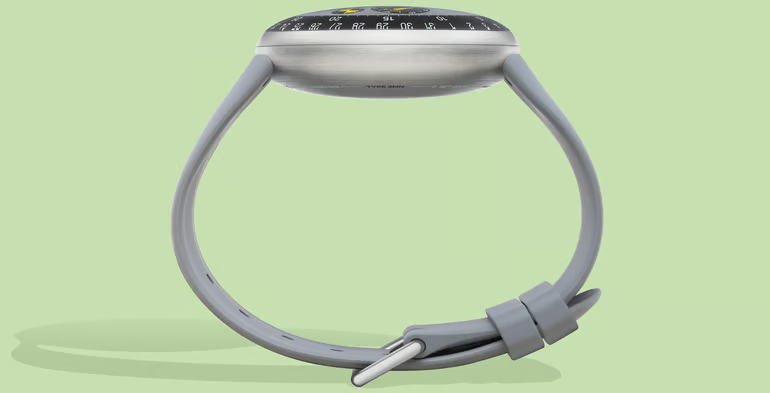
Priced at CHF 46,000 (roughly $57,000) before taxes, it sits in that rarefied zone where “expensive” becomes “editorial.” You’re not paying for diamonds, or for a heritage crest, or even for a complicated chronograph stack; you’re paying for a worldview. Newson’s quote about “synthesising our approaches” isn’t PR fluff; it reads like a mission statement for why this watch exists at all. Reportedly available through Ressence’s online store and a handful of select retailers, it has that modern luxury vibe of minimal distribution and maximum desire. The irony is delicious: a watch this advanced is sold like a piece of contemporary art. And when you consider Newson’s résumé, isn’t that exactly what it is?
What’s most intriguing is how the TYPE 3 MN reframes luxury as experience rather than ornament. The absence of heavy branding, the tactile smoothness, the way the dial behaves like a calm digital UI without ever being digital, that’s a very 2025 kind of status symbol. It’s aspirational not because it’s loud, but because it’s clever in a way only insiders fully appreciate. Worth around the price of a very nice car, it still feels conceptually closer to a prototype you somehow got to keep. The watch doesn’t commemorate Newson’s past as much as it teases his future: this is a designer clearly still restless, still iterating, still curious.