At the CFDA Awards, designers and honorees made a point of sharing credit
The annual ceremony celebrated established figures and emerging talent while speakers repeatedly acknowledged the collaborators and mentors who shaped their work.
The 2026 CFDA Fashion Awards unfolded on Monday as a ceremony notably concerned with attribution. Held at the American Museum of Natural History and presented by Amazon Fashion, the event saw recipients of both honorary and competitive honors repeatedly acknowledge parents, partners, mentors and collaborators whose contributions had gone unnamed in the usual narrative of individual achievement.
Anna Wintour presented Tory Burch with the Positive Change Award, describing a designer whose commitment to social impact was inseparable from her identity. “The quality of positive change is so much a part of who Tory is that I’m not sure she could be any other way if she tried,” Wintour said. Burch, in her remarks, spoke about starting work before resources are secured—a theme that resonated in a room full of people accustomed to the gap between vision and financing.
Recognition across generations
Linda Fargo, who has spent 30 years shaping how collections are presented at Bergdorf Goodman, received the Founder’s Award in honor of Eleanor Lambert, with Michael Kors presenting. She described her approach to retail as one that fuses fashion with commercial selling while maintaining an artistic sensibility. “I feel like I’ve fused this world of fashion with retail but brought it together in a way that hopefully feels artistic and hopefully the designers feel honored,” she said. Beyond the selling floor, Fargo spoke of wanting to bring “fantasy and retail theater” to her work. She also disclosed that she has designated wardrobe pieces in her will for friends and family, joking, “I’m more organized in death than in life.”
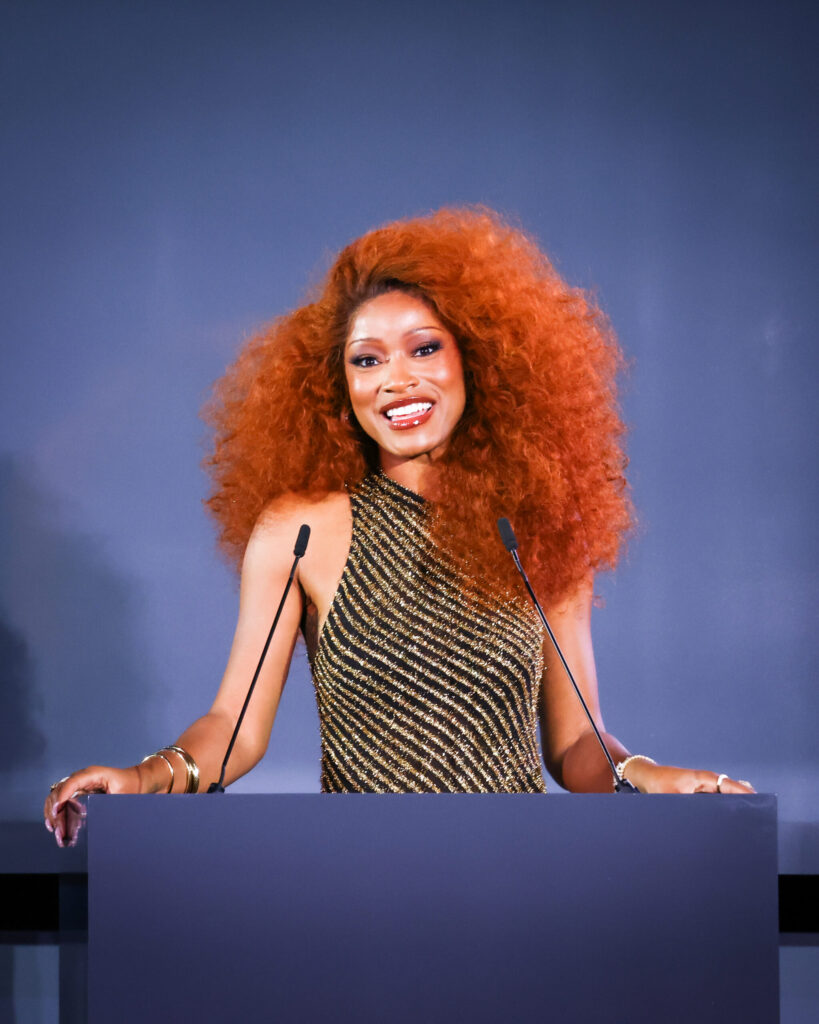
Keke Palmer, the evening’s host, appeared in three separate vintage ensembles: a Stephen Burrows piece from the 1970s, a Bob Mackie gown from 1975 that was originally created for Raquel Welch, and another 1970s look by Marc Bouwer, with her amber hair restyled for each outfit change. She recalled the early days of her career wearing Tory Burch. “We aren’t just wearing clothes,” Palmer said. “We’re wearing a conversation; a statement and a moment.”
Lifetime achievement and new talent
The Geoffrey Beene Lifetime Achievement Award went to photographers Inez and Vinoodh. Inez spoke about fashion’s transformative power: “Clothes can change your life,” she said, reflecting on designers’ capacity to build confidence in those who wear their designs. Eva Chen accepted the Media Award in honor of Eugenia Sheppard, a gesture that prompted her to thank her parents and quote the Notorious B.I.G.’s “It Was All a Dream.”
Rachel Scott of Diotima received the American Womenswear Designer of the Year award. Without a prepared speech, she had arranged for supporters in the audience to assist her if needed. When called to the stage, Scott thanked Thom Browne and the CFDA, along with the women in her life who had supported her, naming her wife. She spoke to the weight of the recognition, viewing it alongside broader challenges facing the field. “I feel extremely lucky and extremely responsible,” Scott said. “We have a lot of work to do starting tomorrow morning.”
Colleen Allen won the Google American Emerging Designer of the Year award and used her acceptance to honor her family and partner. Ralph Lauren took home American Menswear Designer of the Year, receiving a standing ovation. Matt Damon presented the award, offering candid remarks about his own relationship with fashion. “I must admit in my life I’m not very fashion conscious,” he said, explaining that he engages with clothes primarily when preparing for film roles.
Influence and credit
Anthony Vaccarello received International Designer of the Year. Several guests, including Zoë Kravitz, Rosé and Hailey Bieber, wore his Saint Laurent designs to the ceremony.
June Ambrose, working as a stylist and costume designer, raised a distinct question about recognition: who receives credit when ideas travel across continents. She cited American fashion’s impact on European design and the visual influence of music videos on the broader industry. “As a costume designer myself, knowing my contribution in music videos, I’ve seen my influence across the pond as well,” Ambrose said.
Demi Moore presented the Gap Inc. Innovation Award, recalling a cropped denim jacket she wore in a 1990 campaign and later saw her daughter Rumer wear in her own look. “I love that something as simple as a denim jacket could become this beautiful little thread between us, connecting generations,” Moore said. Zac Posen, the company’s executive vice president and creative director, accepted the award with Richard Dickson, Gap’s president and chief executive.
This article was compiled by the Glamorade editorial desk from the official announcements and reporting listed under Sources.